

Hello Gobbledeers,
How’s it going? If you went to Michigan, you’re probably pretty thrilled that your #1 men’s basketball team, #2 women’s basketball team, and #1 men’s hockey team are all playing this weekend in their respective tournaments. Go blue!
We’ve got our next Gobbledy Messaging Cohort starting tomorrow (March 25th) with 1 space open if you’d like to join, and another starting April 7th. 3 sessions, tons of content, great frameworks for homepage messaging. $500. Sign up here.
Today, we’ve got:
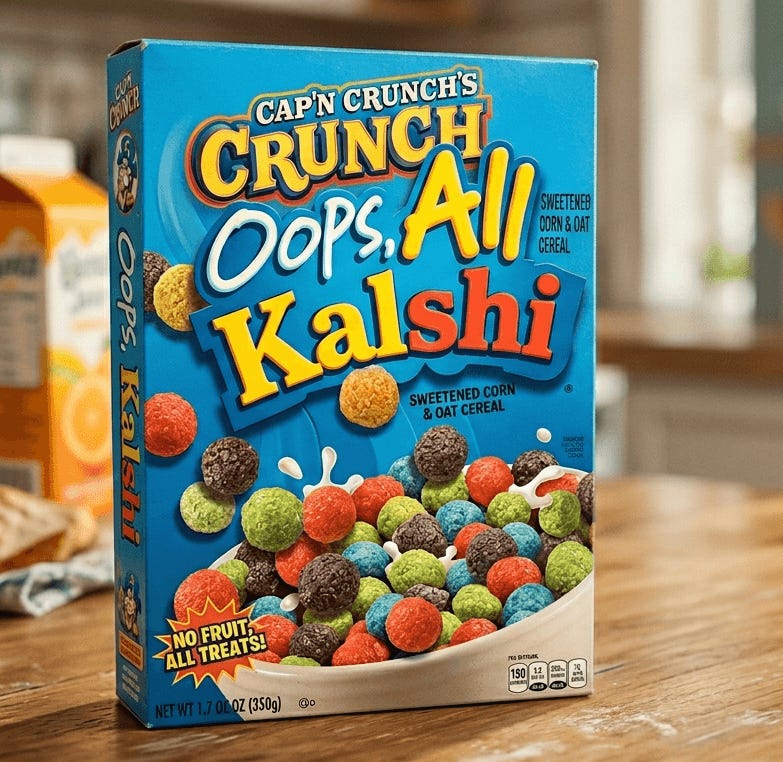
Yes, we’re just talking about prediction market, not-a-gambling-site-but-also-please-wager-on-the-outcome-of-sports company Kalshi and a really interesting positioning conundrum they’ve found themselves in.
What Would You Do: Kalshi Edition
We haven’t played a game of “What Would You Do” in a while, so let’s bust it out today. Maestro, play the WWYD theme music.
[…..]
[…..]
Oh right, we don’t have theme music in a newsletter. Could you maybe hum a little theme song to yourself?
[…..]
While you’re doing that, a whole bunch of years ago we wrote about Schaefer Beer (one of my favorite positioning stories - they positioned as the beer for people who like to drink a LOT of beer in one sitting) and I shared a very very 1970s commercial they ran with Edd Kalehoff playing the Schaefer Beer jingle on a Moog synthesizer. I’m mentioning it here because Kalehoff wrote - among so many other TV music compositions - the theme to the Price Is Right and most (all?) of the music cues that played when they showed prizes. You can waste/enjoy the next hour of your life listening to those here. Also, imagine how difficult that job was?
Producer: “Hey Edd, we need you to write a piece of music that’s 30 seconds long that will get a contestant excited about the possibility of winning a grandfather clock.”
Edd: “Does the contestant want a grandfather clock?”
Producer: “Absolutely not.”
Anyway, here’s the Schaefer commercial:
Sorry, we got distracted there. We were about to play a game.
Here’s the scenario:
You have just gotten a new job, and for that - congrats! You got through the AI resume screener, the AI-generated application, the video screener, the virtual interview, the interview with the CEO, the interview with the 9 team members, the interview with the 2 board members, the 3 weeks of not hearing anything from anyone, the sudden call out of the blue from the company asking if you could come in to the office (it’s in Sacramento and you are in Philadelphia) tomorrow for 5 in-person interviews, the 30-day plan, the 60-day plan, the 90-day plan, the 30-60-90 day plan group presentation, the ghosting, the not hearing again for 2 weeks, the assuming they gave the job to someone else, the call asking you to do a Zoom tomorrow where you’ll present your 18-month demand gen plan to the entire company, then the offer, then the being flabbergasted that the offer was nothing like what they said it would be, the confusion when they tell you that that actually wasn’t the offer for you, the receiving of the correct offer, the questions you had about the value of the options that are in the offer, the being flummoxed about the “Fluzzio.ai equity calculator,” the giving up on playing with the “Fluzzio.ai equity calculator,” and the signing of the offer without even bothering to look at it because you’ve been out of work for 8 months.
And now you are the Chief Marketing Officer of Kalshi.
If you are not familiar with Kalshi, it is what is legally known as a “designated contract market” and what is colloquially known as a “prediction market.” Both of those things mean that people can place contracts on “binary outcomes” of various events. For example, “will the high temperature in Phoenix hit 108 degrees on Tuesday?” or “Will the incredibly annoying and overrated movie Marty Supreme win Best Picture at the Oscars?” People can then enter into a contract with another user on the platform (basically) on “yes” or “no.”
Last year, Kalshi expanded into sports betting. Well, close. Kalshi began allowing contracts on the outcome of sports events. Whereas FanDuel and DraftKings take bets on sporting events, Kalshi merely handles the contract between people on the platform. They do not take the bet - they just make the market and process the transaction. And as such, they are governed by US securities law (like a stock market), not by laws covering gambling.
If you are a normal person, you are thinking to yourself, “that sure sounds an awful lot like sports betting.” And just this week, a Arizona sued Kalshi for running an illegal sports betting business while Nevada got Kalshi shut down for sports “contracts” in the state.
But you are not a normal person - you are the CMO. And as CMO it is your job to both get the public (and legislators) to accept that Kalshi is a great place to wager (er, “contract”?) on the outcome of basketball games, and at the same time convince lawmakers that you’re not doing anything illegal.
So, what would you do?
I’ll give you 3 options, and you can decide what you would’ve done (or guess what they actually did. I don’t really care - there won’t be a grade. Actually, sorry. There will be a grade. But good news, you can drop the lowest grade in the semester. But bad news, this is the only grade you’ll get. So if you drop the grade, you’ll get an incomplete, and then you’ll have to re-take this again next semester. Except - and don’t tell anyone - you can take this class at the community college 15 minutes from here and that will count. But don’t say that I told you that.)
Option 1: Don’t mention sports betting at all. Come up with a cutesy campaign around “predictions” and how if you think you have a crystal ball you can make a living using that crystal ball. Or whatever. You run a campaign that has nothing to do with sports - because sports bettors are very aware that you exist - and everything to do with owning “predictions.” Also, Jason Momoa stars in the ads.
Option 2: Declare victory. Meaning, you will absolutely 1000% own sports betting. Screw it, if you just pretend this isn’t a gray area of some sort (there are so many shades of gray), and just say “we’re the leader in sports betting,” then what is there to argue about? Or, better yet, let’s call it option 2b: you re-position “sports betting” as “sports predictions.” Predicting sports isn’t illegal. Nobody really talked about predicting sports before, they talked about sports betting; you can own this category!
(Side note: for those of you under the age of 40, in the 1970s CBS had a guy on their NFL pregame show named - er, nicknamed - Jimmy the Greek who “predicted” or “picked” the scores of upcoming games. Sports gambling and sports predicting and sports picking and sports contracts and sports whatever were all very illegal at that point, and it’s one of those insane 1970s things that despite the illegality of sports whatevering, CBS hired a gentleman to come on and - with a wink - predict the scores of the games for no particular reason. Also, “Jimmy the Greek.” I’m not sure any sports show would, today, have Julio the Puerto Rican picking games. Even if that’s legal. OK Barstool Sports absolutely would. My bad.)

Option 3: Run a campaign that explains the nuances of why you’re a predictions platform and not a gambling site, and hope that by explaining the details, that no lawmakers will ban your from offering your product in their state.
Now, before we get to the answer, these are all positioning options that they have. They can position themselves against “bar conversations” - like, “hey, what do you think the low temperature will be next Tuesday? I bet you a beer it’s below 30 degrees.” Or they can position themselves against gambling websites. Or they can position themselves against gambling websites, but suggesting the way in which you gamble is more enjoyable in some way.
Positioning is interesting.
Anyway, they’ve gone with Option 3. And they’re running an fascinating campaign that is saying, “you can’t shut us down, we don’t do anything illegal.” Which is true! True-ish!
Here are the 5 ads they’re running:
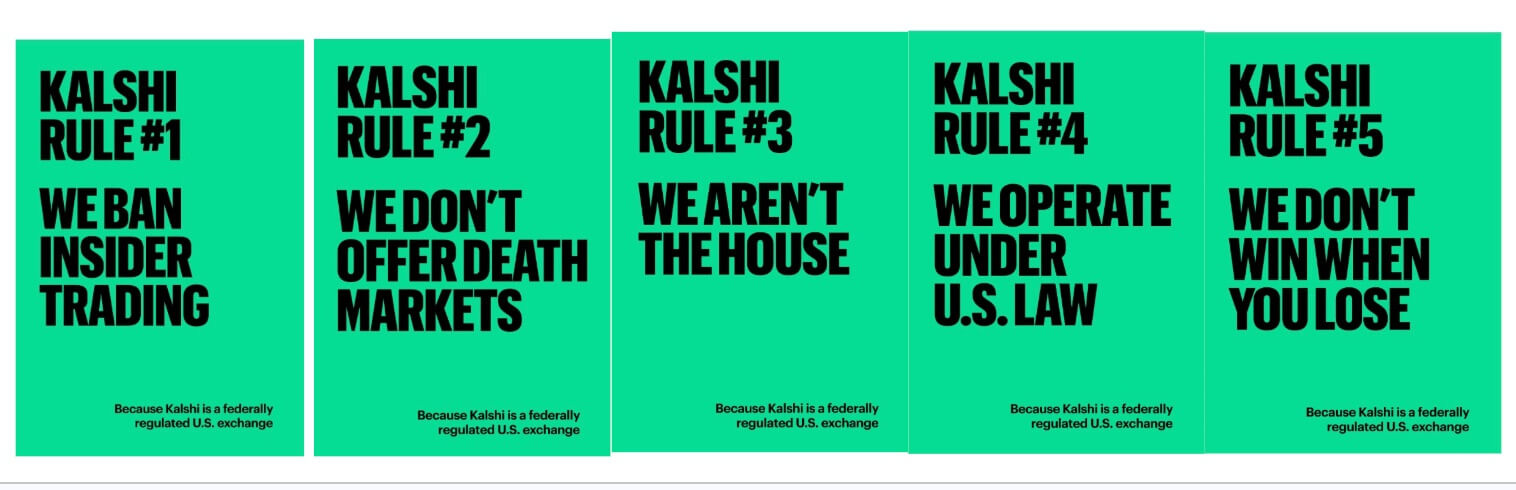
I think that “We don’t offer death markets” is just, I dunno…bravo. Because when I see that I think either:
“What are death markets?”
or
A bet on “Will there be regime change in Iran before March 31st” is not a death market, but also it’s not not a death market?
I also can appreciate, “We operate under U.S. law,” though maybe every company could say that?

I offered 3 options up above, but I think option 1 - come up with a campaign about “predictions” (or some other concept) - is probably their best bet. I’m thinking about other products that are legal but some think should not be legal. Cigarettes, for example. Back when it was legal to advertise them, we saw 3 successful ways to position the product:
Way 1: Camel’s “More Doctors Smoke Camels Than Any Other Cigarette” approach. Which is - “if this product were bad, why would doctors be smoking it?” For Kalshi, this would be something like a celebrity endorser - “if this product were bad, why is Sabrina Carpenter telling me to use it?”
Way 2: The Marlboro Man. The Marlboro Man represented freedom and rugged masculinity. The product was positioned as a way to show that you embrace freedom and are a real man. That may sound goofy in today’s world, but lordy was it successful. The choice to smoke was a choice for freedom. In Kalshi world, this would require messaging like, “Bet where YOU choose…”
Way 3: Virginia Slims. Basically Marlboro, but for women. Smoking Virginia Slims represented how a modern, liberated and free woman showed that she was modern, liberated and free. This would be an interesting approach for Kalshi - could they show that modern women who is informed enough about sports betting would always choose Kalshi.
And now that you’ve read all of that about Kalshi, it may - may! - not surprise you that their founder posted the video below on Twitter/X. Because I care about you, I will tell you in advance it is their board members - for reasons I cannot even begin to imagine - doing pushups outside on the street after their board meeting.
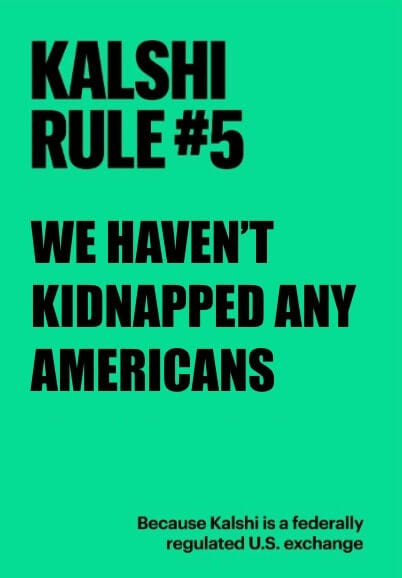
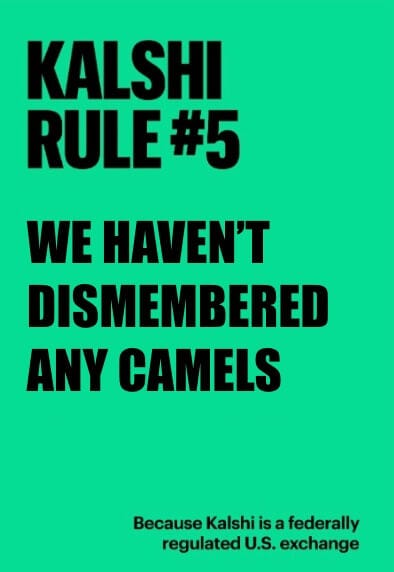
I know we just went through that entire thought exercise about how this company might position themselves, the real answer is that they’re the company whose founder approved a campaign that says they do not allow you to bet on people being killed, and also thinks that posting a video of the board doing* pushups somehow reflects positively on their company.
(*doing = attempting to do)

My bet? You’re glad you don’t work there.
As always, thanks for reading to the end - it’s the best part.
Friendly reminder about the upcoming Gobbledy Messaging Cohorts. More here.
P.S. Somehow I’ve never heard of the drummer Jonathan Moffett (he played with Michael Jackson). This video of him performing Smooth Criminal is absolutely incredible. I always assumed a drum machine was playing the part. His precision is ridiculous - and listen for how he leaves space in there. He’s not a guy who has to bang away constantly. Really remarkable.
Sounds like you have Opinions on Marty Supreme...
I'll let the real professionals comment on the positioning and I'll just leave here that if you enjoyed that clip of Sugarfoot (I sure did) you are likely to love this one of the late, truly great Jeff Porcaro breaking down one of the most legendary beats of all of 80s music: https://www.youtube.com/watch?v=6wtdm5U47hM