

Hello Gobbledeers,
How’s it going? Yes, we’ve come to the last of the summer reruns. I already feel like I’m behind on next week’s brand new (!) newsletter - (because I am).
One quick note before we jump in to this week’s Gobbledy Classic (tm):
As I’ve mentioned here more than you’d like and yet less than I’d like, that I went to Michigan for college, and when I was at school I spent a some time with a guy named Michael Brooks, who ran Michigan’s Hillel (an organization for Jewish students on campus).
After I graduated I worked for the University for a few years, and we would have lunch periodically (and he would kick my ass in racquetball periodically, which is to say every time we played. Also I find it hard to imagine that there was a time when I played racquetball.)
Michael passed away this week, and one of the things I’ve come to realize over time is that there are people in my life who have had an outsized impact on me - the amount I think about them is disproportionate to the amount of time we had spent together.
I was a little lost professionally (and perhaps otherwise) after I graduated, and Michael would patiently listen to me talk about my lack of direction, and he shared two things that I think about all the time, and that I will now share with you. I’m sharing them with you because perhaps you have 22-year olds in your life who, unlike many 22-year olds nowadays, have not gone into consulting or finance and can’t figure out what they’re doing. Michael told me this:
“Some people just shoot an arrow at the bullseye — they know what they’re going to do, and they work toward it and someday if it works out they’ll get there. For you, you’ll shoot your arrow and you’ll figure out how to move the bullseye to it.” This was 30 years ago, and I will say that that is exactly how my career has turned out - I have figured out what I like doing, what I’m good at, and figured out how to get people to pay me to do those things. For people in their early 20s, I think it’s a good reminder that they have abilities and skills that can be applied in lots of ways, and that they don’t have to figure that out immediately.
He also talked me off the ledge once by asking me what I imagined the worst outcome of my job search could possibly be. I said that I would imagine if I couldn’t find a job that I would have to work at McDonald’s. He said, “OK, then you work at McDonald’s. I’d guess that if you did that you’d be noticed by the manager pretty quickly as someone who is competent and they’d make you assistant manager. And after a few months, it would be obvious that you could run a McDonald’s, no? And after you did that for a year, don’t you think the regional manager would recognize that your McDonald’s was performing really well? And that they should give you other McDonald’s to run? And if you did that that the corporate office would notice that and eventually you’d be an executive at McDonald’s? So the worst possible outcome for you is that you’re an executive at McDonald’s.”
And yes, I know that sounds simple and silly, but I’ve repeated it to people so many times. Because at 22 or 23 it often seems like you may never get a career (or find a job) and that after graduating you are set up for failure when everyone around you has succeeded (or is in the process of heading toward that bullseye.). But in reality, the worst case scenario is you’re a successful executive at one of the world’s best known companies.
Michael gave me so much perspective at a time when I needed it (including that a 50 year old can kick a 23-year old’s ass in racquetball).
He was incredibly influential on a couple of generations of Jewish kids at Michigan - his passing is a huge loss. There are so many things he said that I think about all the time. May his memory be a blessing.
Though it would be wrong of me if I didn’t also share that he liked to tell somewhat dirty jokes, and my friend Ian and I often tell this one:
A guy is arrested after he is caught having intimate relations with a goat. A friend tells him that he absolutely has to hire this one specific lawyer for this case. He hems and haws because he’s never heard of the guy, but decides he’ll hire him. He meets the lawyer and the lawyer tells him, “I am a master of picking juries, and I promise you I will find you a jury that will acquit you.” Now the guy is skeptical, because he was, in fact, caught having intimate relations with the goat, but he trusts the attorney. So the trial starts and he’s called to the witness stand, and the prosecutor is interrogating him about the evening. Where were you? How did you get this goat? Has this happened before? Etc. And then she asks, “When you were caught, is it true that the goat was performing oral sex on you?” And one of the jury members turns to the guy next to him and says, “A good goat will do that.”
In this week’s GC (tm), we talk about group showers at work, and the un-death of Barnes & Noble.
We’ll Brainstorm Right After the Group Shower
I think there’s a common progression for people working in tech when it comes to doing fun (or “fun”) activities at work:
When you’re a young person it’s like you’ve tripped across this magical land that has no resemblance to the sad insurance brokerage your father worked in in suburban New Jersey. Sure, he needed a drink at the end of every work day, but he had to come home to have that drink - they sure as hell weren’t giving it out in the office in Parsippany. No, your office is chock-a-block with 20somethings and your company is amazing and hands out drinks in the office at 4 o’clock (it’s 4 o’clock somewhere) and you hang around the office for a while and play board games or whatever.
Then you move up in the ranks and you’re getting invited to the offsite retreats and they’re flying you to Phoenix to go hang with the team and do some planning and 4 free days of vacation are amazing and what’s better than hanging out with your buddies from work while doing ice breakers and having drinks at 4 o’clock before paintball?
Then you’ve done that for a few years and maybe you’ve got a family and suddenly 4 days in Phoenix seems like an awful lot of days in Phoenix to be away from the family so you can have drinks and do planning.
And THEN you’re me, and you’re in your mid-40s a few years back and you really, really, really don’t want to go to Phoenix (or its east coast equivalent) and you decide to speak to someone else on the exec team about how maybe we can just meet in the office instead of being away from our families for a few days to blah blah blah about the next quarter. Then you regret that decision when it comes back to bite you firmly and squarely on your ass.
Which is all to say that now that I’ve been off on my own for a while, I do not miss work offsites. However, some people still like them…from the WSJ:
Anson Whitmer had a bracing solution to a flagging afternoon meeting at his company’s recent employee retreat.
“We need to shake things up,” he said, clapping his hands to wake one dozing attendee. Whitmer, chief executive of Mental, a wellness app, then ushered his fully clothed staff of four into a walk-in shower at the Lake Tahoe retreat site and turned its two nozzles on to ice-cold blast.
“This feels like being shot by a BB gun!” shouted Jason Kyle, Mental’s head of content. His equally drenched co-workers howled and cursed. After a towel-dry and change of clothes, Kyle kicked off a brainstorming exercise on new audio concepts for the app.1
“It was probably our best session of the entire retreat,” Kyle said.
I can see why the app is named Mental.
A Good CEO Is Actually Really Valuable, Barnes & Noble Edition
Let’s imagine for a moment that 20ish years ago you worked in marketing for a bookstore. Congrats on the job! Also, uh oh.
Amazon was around and was selling books, and they were growing, which may have concerned you somewhat, but also you probably went around telling whoever would listen that people love going to malls and shopping, and nobody will ever stop going to malls and shopping, and the 4th marketing ‘p’ is “place” and as long as Amazon is online and you’re in the mall, there’s probably - nay, definitely! - room for both of you.
If you ran the bookstore Borders, you definitely believe that there’s room for both of you because in a move lost to history, but which somehow didn’t seem completely bonkers at the time, they called up Amazon (yes, the same bookselling Amazon we have today), and said to them, “Hey Amazon, you’re really good at selling books online, and we’re really good at selling books in malls, which people will definitely go to forever, so would you mind running our website for us?”2
And I have to imagine that the folks at Amazon got into a conference room and either laughed themselves silly, or whispered, “Those Borders guys are based in Ann Arbor, where marijuana is basically legal, so they must be high, right?”
I assume the reason that Amazon still has the press release announcing this alliance on their website is because they still can’t believe Borders agreed to it.
This is my favorite part:
Amazon.com will be the seller of record, providing inventory, fulfillment, site content and customer service for the co-branded site. The new site will continue to offer content unique to Borders.com, including store location information and in-store event calendars.
In other words, Amazon will steal every single bit of Borders’ business, and in return Borders will get a store locator.
Borders went bankrupt 10 years later.
If, instead, you had worked at Barnes & Noble, you were sure you would not fall for Amazon’s trap and instead you’d go out on your own and run your own damn website.
Barnes & Noble decided they would compete with Amazon by taking advantage of their main point of differentiation: their stores. And they would do this by spending 15 years letting their stores become disgusting3.
It’s here that I’ll note that back in maybe 2017 or so I was in a meeting with some lovely folks from B&N where we were trying to sell them some software, and every time we brought up something that we thought the software could do to help them, they had some reason why it wouldn’t work. The people we met with were so lovely and so beaten to a pulp and so sad. I saved a photo of them from the meeting:
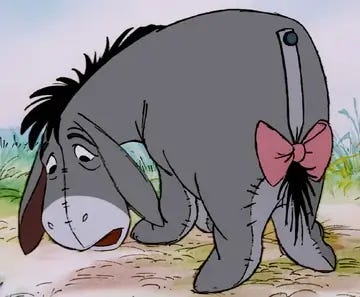
Fast forward and B&N was left to the remainder pile of history (that’s a book reference….clever!)
Except not quite. They hired a new CEO in 2019 and he’s begun a really remarkable turnaround.
Both the NY Times and the WSJ recently wrote articles about the CEO’s so-far-successful efforts at a re-boot of Barnes & Noble (which, I suppose, says as much about their PR firm as it does anything else).
James Daunt, B&N’s CEO (as well as the owner of his own bookstore in London and managing director of British bookstore chain Waterstones), threw out all the rules about running a chain and re-focused the company entirely on letting store managers create a tailored experience for the particular shoppers in that location.
That does not sound revolutionary, I know. Except it is.
Typically in a chain, you are creating consistency. Same logo, same signage, same layout, same assortment (for the most part).
B&N has thrown that out (they have several logos that they’re using in different stores), and has placed trust in the store managers to work with the store design and merchandising teams to build a store that those specific store shoppers will love.
The guiding principle, I think, is summed up by their head of store design: “You need to love books, and you need to know how our customers shop for books.”
OK, it’s also summed up by CEO Daunt: “We’re here to help people browse…”
That was really striking to me. I’ve heard so many nonsense missions from software companies over the years (most of which sound like “we want a world where customer lifetime value is augmented through highly personalized marketing messages” or whatever).
I made that up. But here’s martech company Yotpo’s mission statement: “We're on a mission to provide brands with everything they need to create winning customer experiences, from discovery to purchase.” (Kinda the same, no?)
What I love about Daunt’s message around “helping people browse” is that it cannot be used by their biggest competitor. Say what you will about Yotpo’s mission statement, but it can also be said by pretty much every single company that does whatever Yotpo does.
Barnes & Noble’s statement works because it includes both the main differentiator from its competition, but also is about how it helps customers.
I’m mentioning all this, because I think B&N’s turnaround is (at least so far) successful because of these 4 things:
The mission addresses the company (we help customers browse), the competition (Amazon isn’t about browsing), and customers (browsing books should be joyful.)
The CEO and the people he’s hired are truly passionate about the product.
The CEO told his team that all the old rules don’t apply.
The CEO trusts his team to put the mission into practice.
We marketers don’t talk about it much, but our success is almost entirely dependent on the strength of our CEO. Really. In the stories we tend to tell about ourselves, we are the heroes (obviously) and sales are the bad guys (boo!) who don’t understand what we’re trying to do because all they care about is (vomit) closing deals. But I’m sure most (all?) of the who-knows-how-many heads of marketing B&N had over the past 20 years were doing something resembling a very good job marketing.
And while very good marketing is, uh, very good, without a CEO who provides a vision - and then actually trusts the team to execute - you’re in trouble.
Next week - I’ll share a couple of pieces of marketing that show what’s possible when you have vision + trust. (Oooh, a teaser!)
OK Fine, One Last Thing
At some point someone had to tell you how to dial the phone.
(Thanks for sending, Dad!)
I have a couple of additional thoughts on this story. First, which is worse: The BB gun cold water shower, or the brainstorming exercise for new ideas for the audio app? (That’s a rhetorical question - obviously the brainstorming.). Second, this anecdote was in the Wall Street Journal, and the Mental CEO thought that telling it to a reporter would reflect well on the company. Just something to consider if you see a job opening there, as they’re clearly looking for people who love BB gun cold showers followed by app brainstorms. Also, it was all guys.
I think it actually happened the other way around, where Amazon was pitching other companies and telling them to use their expertise online and let them run their websites for them. Incredibly, Borders, Target and Toys ‘r’ Us all took them up on that offer. In any case, you’re not reading Gobbledy because it’s exactly historically accurate (I hope).
Hardy har. B&N was (I believe) the first online retailer to offer same-day delivery, which they did wayyyyyyy back in 2000 in Manhattan. It’s hard to remember what a crazy idea this was - and they charged the same $3.95 delivery for same-day delivery as they did for regular delivery. It was so crazy that the CEO who came up with this idea was no longer the CEO by the time it was implemented.
I didn't need the footnote to tell me that the cold shower company was all guys.
I'm sending Michael's two thoughts separately, and I hope I don't mix them up.