
Oops, All Fun ("Fun") Marketing Activities Edition
Sometimes work gets in the way of work

Hello Gobbledeers,
How’s it going?
Since this is, ostensibly, a newsletter about positioning, I thought I could deliberate publicly about how to position this issue of the newsletter:
One way I could position today’s newsletter is that I was traveling for the past few days and I’m traveling for the next few days and I’ve been busy with actual work that someone (gasp!) pays me to do and so I haven’t had the opportunity to set aside my normal time to write Gobbledy. So I’ve gone through a bunch of past issues and pulled out all the times I suggested a fun (“fun”) activity for your team to do because I didn’t have time for new content.
Orrrrrrrrr….
I could position this as a way to offer my readers an amazing opportunity to learn a whole bunch of different activities they can do with their marketing teams that will be fun (“fun”) and also help make your product’s messaging clearer.
I say we go with the second option.
Today: 5 Fun (“Fun”) exercises to do with your marketing team.
Exercise #1: Turn Your Shortcoming into a Benefit
In an early issue of Gobbledy, we talked about how one of the keys to Warby Parker’s early success was that they constantly talked about how massive global eyewaker maker Luxottica was single-handedly responsible for making your glasses cost $600 when they should actually cost $95. Every bit of PR they did included talking about how Luxottica was responsible for making glasses ridiculously expensive. They were the enemy.
Here’s your fun (“fun”) exercise - Ask your team: Who is your enemy? Who’s your Luxottica? It doesn’t have to be a company. It can be an idea (“doing things manually” is an effective enemy, for example).
Being comfortable narrowing down your target market (and letting go of non-target markets), and then telling them why you’re better than the enemy. You don’t have to be better than everyone.
(Just a note — you will get pushback on the “narrowing down your target market” part. Letting go of non-target markets is very, very uncomfortable for your sales team, even though letting go will make the sales process easier. You will be blamed for any slips in revenue, because you narrowed the number of targets. And because you work in marketing. And part of our job in marketing is to be blamed. Except for you. You’re doing a great job. Keep up the good work! I wish you the best of luck.)
Every shortcoming you have can be re-cast as a, uh, longcoming(?).
Missing some of the sophisticated features of your more mature competitors? Maybe you go with “Easy implementation” or “For XXX who want to focus on revenue, not implementation” or “Everything you need, with none of the fluff”. Whatever.
Or maybe it’s the opposite - you have all the features, but going live is complex. Maybe you need an expensive team of system implementers to get up and running? You could go with - “Backed by an army of experts.”
Don’t have integrations with some of the software your prospects use? “The platform chosen by 4 out of 5 companies that use XXXX software” (that you do integrate with).
Your shortcomings could be the key to becoming the next Warby Parker. Of software.
Exercise #2: You’re One Word Away…
I’ve mentioned how a friend’s poetry professor used to talk about the “money word” in a poem - the word that does much of the heavy lifting and draws attention to a key theme (or, y’know, whatever).
Behold this email from Chirp, a purveyor of some sort of massage table that helps relieve back pain:
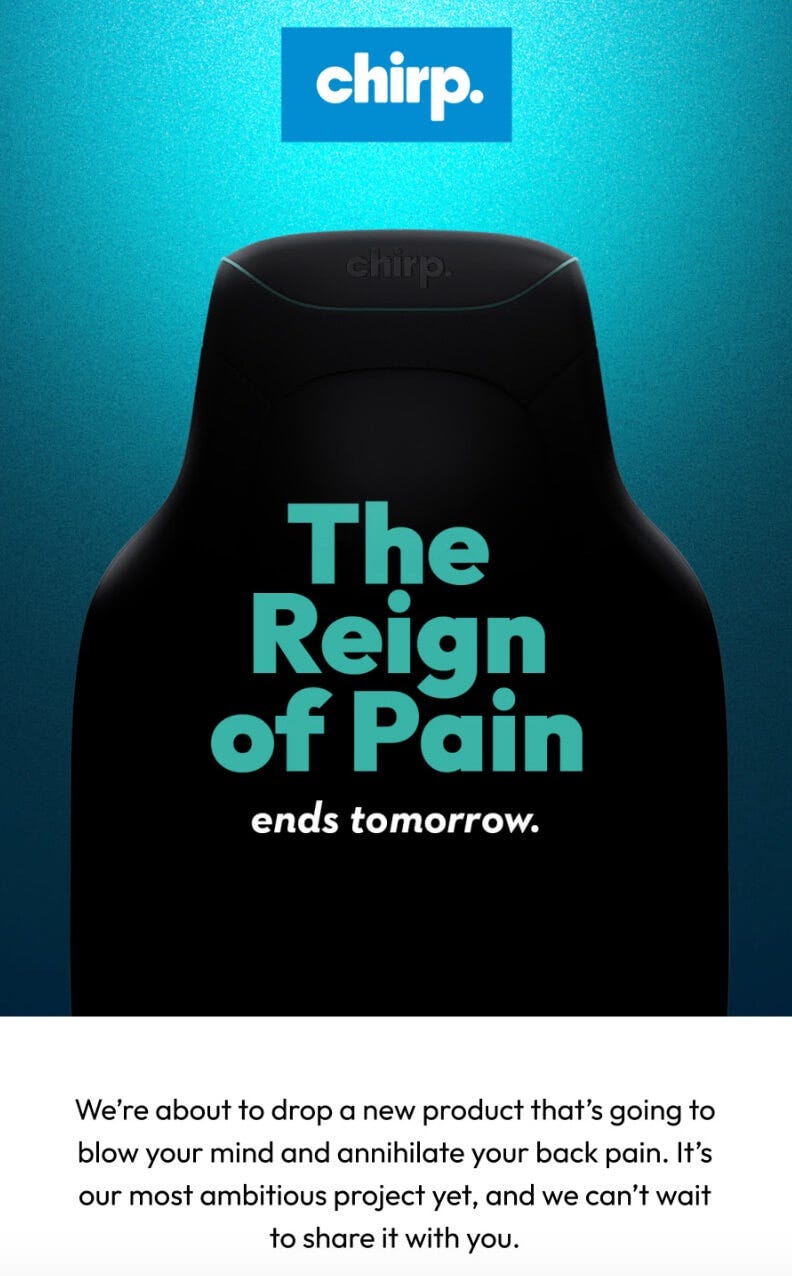
Read that copy. What’s the money word?
No, not “to.” That’s not the money word. What in God’s name is wrong with you?
It’s “annihilate.” The product they’re introducing will “annihilate your back pain.”
It’s a great bit of copywriting, and it’s something you can steal if you’d like to, ahem, annihilate the boring in your copy.
Here’s a tagline that AI somethingsomething Instabase uses on their homepage:
“Unlock the potential of your enterprise data with AI.”
But you know who also uses that phrase? Lots of companies:
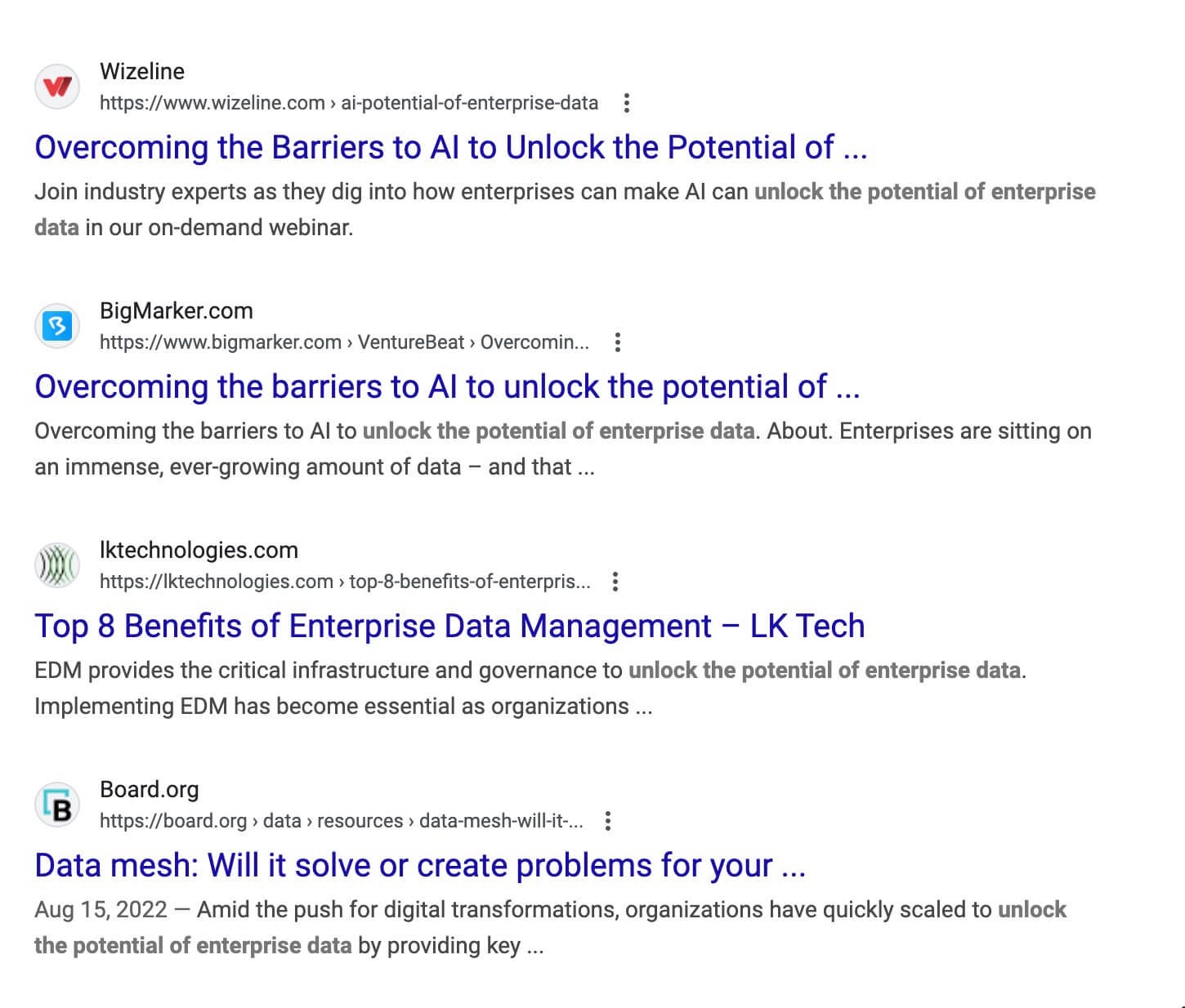
What could be the money word here?
How about:
“UNCORK the potential of your enterprise data with AI”
“LIBERATE the potential of your enterprise data with AI”
“UNCHAIN the potential of your enterprise data with AI”
“EXPLODE the potential of your enterprise data with AI”
“UNSHACKLE the potential of your enterprise data with AI”
Your homepage headline or subhead should have a money word that you can own.
Here’s the fun (“fun”) exercise: Gather the marketing team around. No - first, send a calendar invite for 10 minutes from now. Have the meeting title be “Team Update.” Or “Marketing Changes.” Watch how nervous they all are. Ha ha ha. That’s hilarious.
Then when they arrive, give them a little “Hey guys, you may be wondering why I gathered you here with only 10 minutes’ notice.”
Hoo boy, won’t they be relieved when you tell them you just want to do a little exercise.
Anyway, ask them to brainstorm a change to 1 word in your homepage headline or subhead. Just 1. They’ll be pleasantly surprised that you didn’t quit and they weren’t being let go. Suddenly doing a little work seems fun! You’re a good boss.
I promise there’ll be a word that they come up with (besides the word where they describe you as an “asshole”) that is a giant leap better than what’s on your page now.
Exercise #3: There’s One Reason You’re Better
I was so happy when I saw this ad from apparel brand Fabletics because the headline expressed the product’s core benefit so clearly:

If you were a dude who plays golf and was in the market for pants, and you were wondering why you should buy Fabletics pants instead of pants sold by another schmatta hawker like - for example - Lululemon, I think saying that the pants are “like Lulu but a third of the price” is pretty brilliant.
Here’s the fun (“fun”) exercise - what’s the most obvious way your product is better than your biggest competitor, and don’t worry about whether anyone cares about that reason. How is it different? Now, mock up your homepage where “Like Salesforce, but our font is larger” and see how clear and obvious it is on your site.
Now, go show it to people internally. You did that? Great. Now, die a little inside every time you have that conversation because everyone is going to tell you a hundred things you forgot to put in there.
Now it’s time to go back to your desk and reconsider why you got into marketing in the first place. But you’ll have the satisfaction of knowing you’re right.
Exercise #4: The Brand Voice You’ve Always Wanted
As my friend and sometime-Gobbledy reader JVC once said about losing weight, “it’s simple, but it’s not easy.”
Which is also how I’d describe marketing for software companies, except that it’s simple, but we make it mindblowingly not-easy by generally trying to do anything that would make us look any different from any of our competitors.
This is how I think of software marketing:

Anyway, if you’re thinking to yourself, “I’d love for us not to look and sound exactly like every one of our competitors, but I just don’t know how to do that,” you’ve come to the right place. Or at least you’ve come to A place, which is really the first step.
Here’s the fun (“fun”) exercise I’ll suggest that will help you figure out where to start:
Take any page on your website that’s not the homepage, and then change it into the voice that you always wished your brand had.
One of the things we talk about here sometimes is that every touchpoint you have should sound like your brand voice. We talked about one of my favorite examples of this back in the early days of Gobbledy where I shared an order confirmation from “multi collagen peptide” (?) provider Vitauthority that’s so great, I’m going to put it right here:
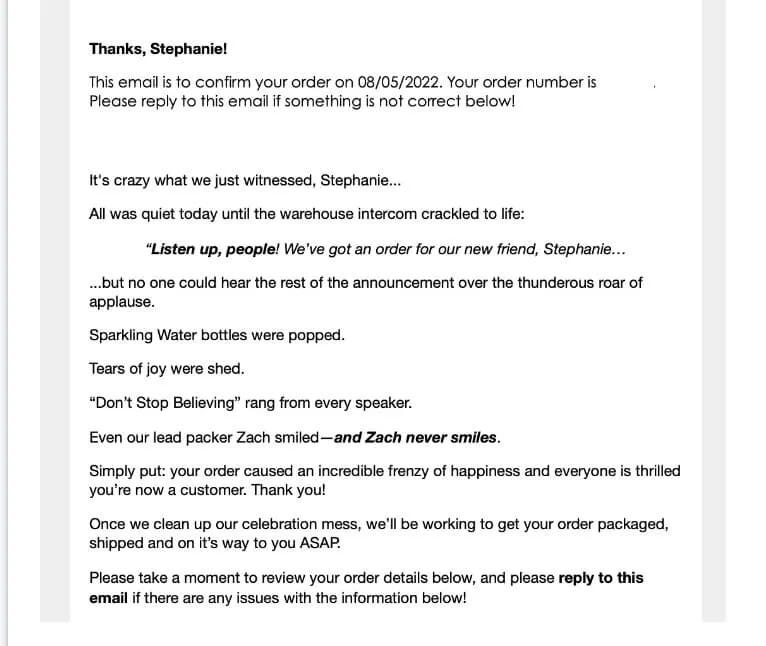
Every touchpoint should be that good.
Which is why as a marketer you have SO MANY OPPORTUNITIES to have your brand voice come through. But almost no companies bother to do that. And sure, I’ll gladly help you with your homepage (hit me up at jared@sagelett.com - also, please don’t say “hit me up”), but it’s easier to start somewhere that’s less visible.
You could start on your Pricing page, for example.
And specifically as an example, I wanted to share the pricing page from testing tool Posthog.
The top part of the page is a regular pricing page, but if you keep scrolling you get this:
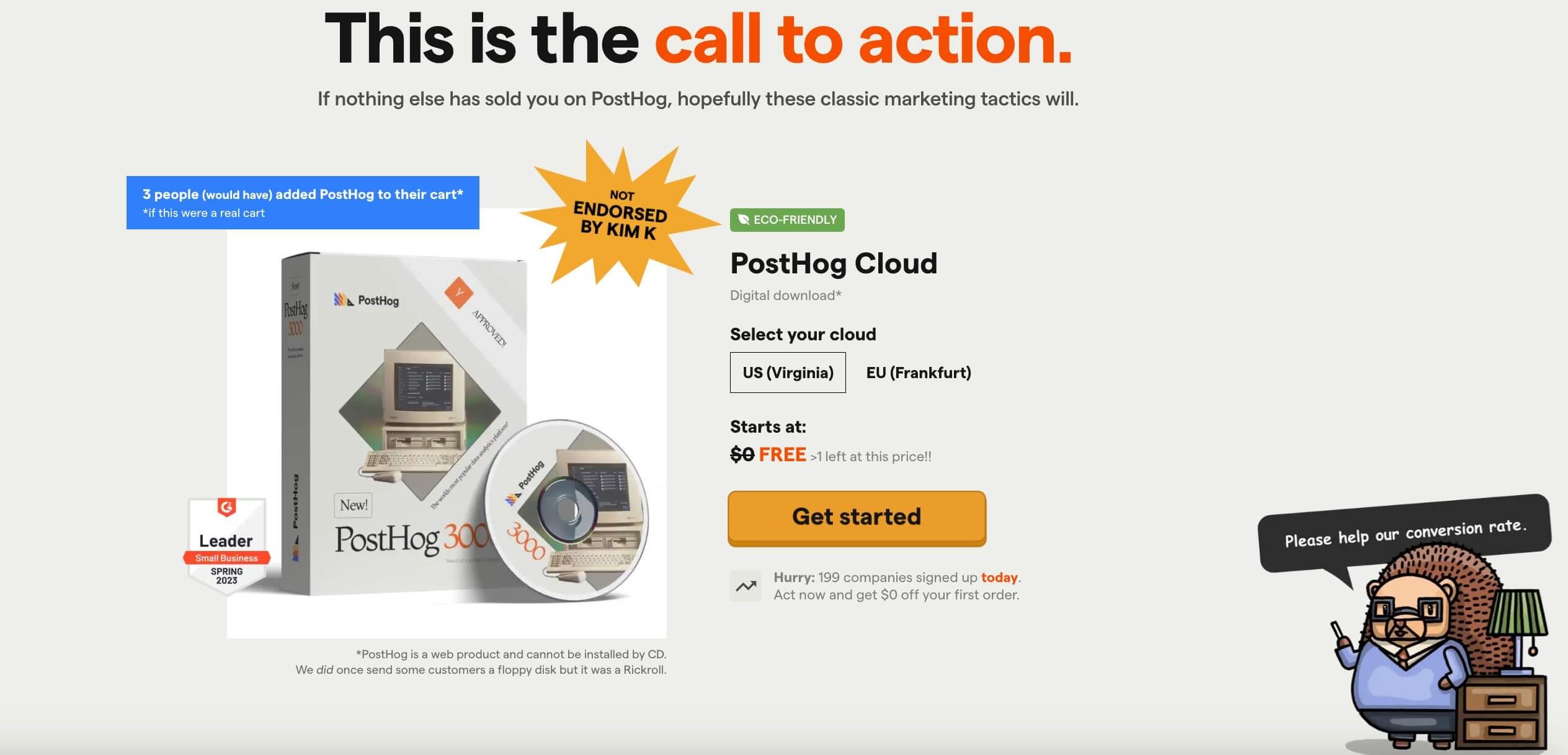
“If nothing else has sold you on PostHog, hopefully these classic marketing tactics will.” Love it. The little hog on the bottom right saying, “Please help our conversion rate.” Amazing. “Act now and get $0 off your order.” All of it, brilliant.
I’ve worked a couple of places where someone has said something like, “Developers don’t like to be sold to. Just give them information.” Which I mean, sure? But one way you “don’t sell to” someone is to tell them you’re selling to them. Which PostHog has done here in just an incredible fashion. I’m jealous.
You don’t have to wallow in jealousy - tell your team they have the freedom to try a new voice on an existing page and watch the creativity flow.
Exercise 5: What If You Had an X, But It Could Y…
I wanted to share an ancient example of how “It’s like this thing you like, but better in these specific ways” can serve as a template for companies struggling to talk about why people should care that their product now contains AI.
The example starts with a construction that any company can use to explain the benefit of your product:
“What if you had an X, but it could also Y”
Behold, an amazing ad for the 1963 Ford Econoline Van:
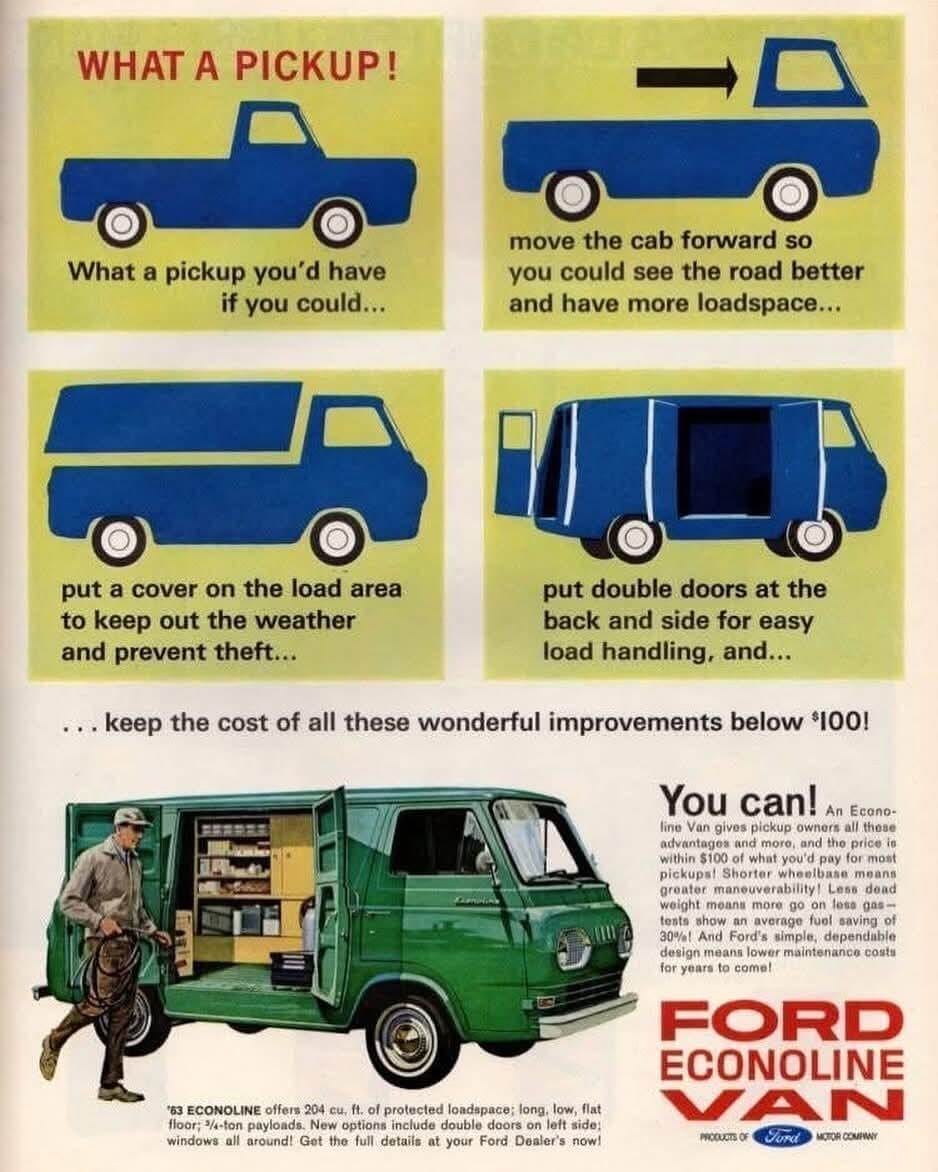
I can’t, in good conscience, bore you with a history of vans in the United States, so just know that vans were a new-ish product in the United States in 1963.
(OK fine…Volkswagen created the van in the early 1950s as a kind of enclosed pickup truck to transport items. The passenger van - the one where you should not go a-knockin’ if it is a-rockin’ - didn’t come along until the early 1970s when Dodge introduced one).
So people who were buying a van in 1963 were likely replacing a pickup truck. Which is why it would make sense to say, “what if you had a pickup, but it could also…have better road visibility, carry more cargo, and keep that cargo secure…”
We often hear that software messaging shouldn’t focus on the functionality - it should only focus on the benefits.
But one of the things this ad does well is to focus on the functionality (we moved the cab forward) as a way to talk about the benefit (now you can see the road better). Talking about functionality isn’t the problem, not talking about WHY the functionality exists is the problem.
They continue with that structure in the smaller copy toward the bottom: “Shorter wheelbase means greater maneuverability!” Every feature they mention includes a benefit of having that feature.
Here’s the final fun (“fun”) exercise: get your team together and take the Ford Econoline Van ad and fill it in for your product…(and keep those images, so it’ll be extra confusing…). When I first published this I had a Gobbledy reader write me a few weeks later to tell me they did this with their team and it was really useful. (And yes, I was shocked someone took my suggestion.)
Thanks for reading to the end, it’s the best part. I really do hope you do 1 (all 5?) of the exercises with your team. I’ve always found that my teams like to do something that was a little different than the normal day-to-day stuff, and (usually?) they enjoyed working as a team. This accomplishes both. Let me know how it goes.
P.S. - This has nothing at all to do with marketing, but I just read an incredible book by journalist Brian Goldstone called There’s No Place for Us: Working and Homeless in America. It follows 5 families in Atlanta as they struggle to hold jobs and keep a roof over their heads. It is not a light romp. But if this topic is at all interesting to you, it’s a really fascinating look at how people can work multiple jobs and still struggle with homelessness.