
Please do not set your mascot on fire
..and please don't say your product "helps" you do something

Hello Gobbledeers,
How’s it going?
Question for you:
I’m thinking about running a virtual homepage messaging cohort. The idea would be that a group of 5 people would meet 3-4 times for 45-60 minutes over the course of 2 weeks. During the sessions I’d share best practices for writing a homepage, and in between you’d have short assignments to work on sections of the homepage. And as part of it you’d get 2 sessions 1:1 with me to go over and hone what you’ve written. The cost would be $500.
I’m trying to gauge whether people would be interested in this - the idea is that it’s a super hands-on experience at a reasonable price, and you’d have a well-honed draft of a homepage when you’re done.
If this sounds interesting to you, could you fill out this incredibly quick form (name, email, company) - you’re not signing up for anything right now…I’m just trying to figure out whether there’s interest in doing something like this.
OK, moving on. Today we’ve got:
Don’t help.
Don’t light your mascot on fire.
Mother’s Little Helper
May I share a little annoyance with the gobbledeers?
Yes? Great, thanks so much!
(If you answered no, skip to page 253 to find out if The Searcher is able to slay the wicked Voltor the Hungry in the Castle Bolfenstein).
I cannot explain how many times I read on a software homepage that the product “helps” you do something.
To wit:
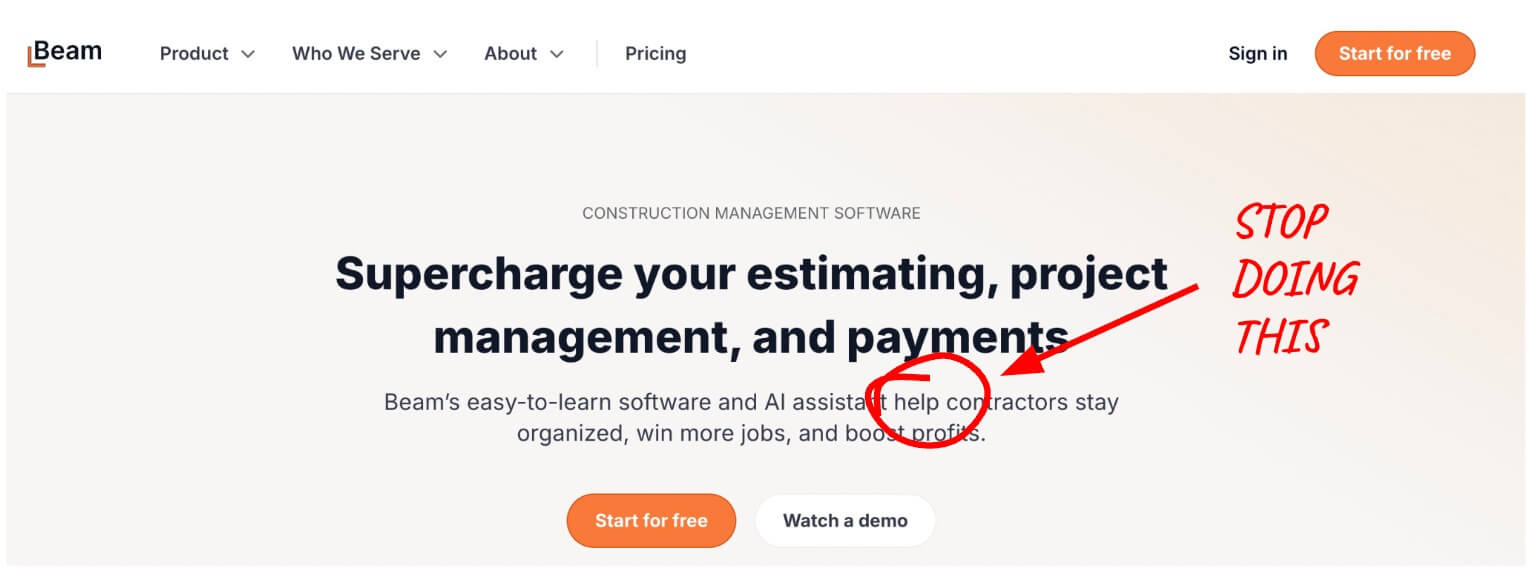
“Helps” weakens the message. It takes away from the power of the product.
Your 4-year old “helps” you make brownies, in that she is not helping at all and likely making more work for you (though it’s wonderful! I wish I still had a 4-year old with whom I could make brownies).
I’ve shared this ages ago, but I wanted to re-share this quote from former MTV News host Tabitha Soren talking about music journalist and MTV personality Kurt Loder:
“Kurt knew every bit of music history. His musicology was just such a gift for me to learn from. Never mind his writing experience. He always said, “Tabitha, you can’t use ‘seems.’ It either is or it isn’t.””
It either is or it isn’t.
Either your product does something or it doesn’t do something. It does not help.
In the case of construction software company Beam (whom I picked on in the image above), they should change their copy from:
“Beam’s easy-to-learn software and AI assistant help contractors stay organized, win more jobs, and boost profits.”
to
“Contractors choose Beam to win more jobs and stay better organized.”
If you have “helps” on your website, take a few minutes and flip that sentence around to tell readers why companies like them choose your product, and the benefits they receive from using it.
(Reading Gobbledy makes your messaging stronger…it doesn’t help you write better messages, y’know?)
The Memories of a Coal Miner’s Mascot
Oh, do I love mascots.
If you’ve been reading Gobbledy for longer than, oh, six weeks, you’ve read me singing the praises of creating a mascot for your company.
I know. I know. We live in the “age of AI” (as every software company webinar and every tech conference session will tell you.) But we’ve always lived in the age of mascots. Well, at least I have.
So let me introduce to you, after spending $1.5 million with Landor Associates and literally hundreds of interviews with subscribers and prospective subscribers, the newest member of the Gobbledy family, Gobb!
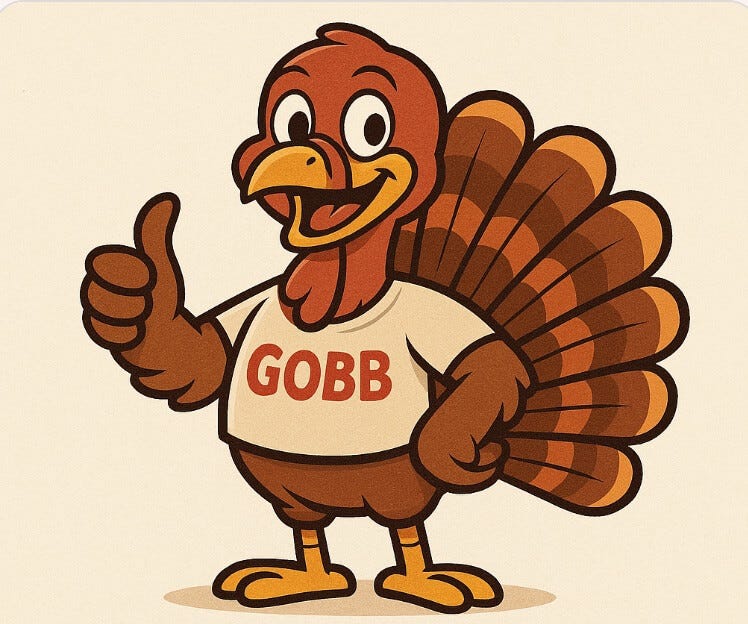
That’s not what I wanted to write about.
I love mascots because in a crowded market they’re an easy shorthand for people to remember you. And because virtually every software market is now a very crowded market I have not understood why software companies are so adverse to using a mascot.
This is a real mystery for me. Every company complains about how difficult it is to stand out. Sadly, THIS is how you stand out!
Also this:
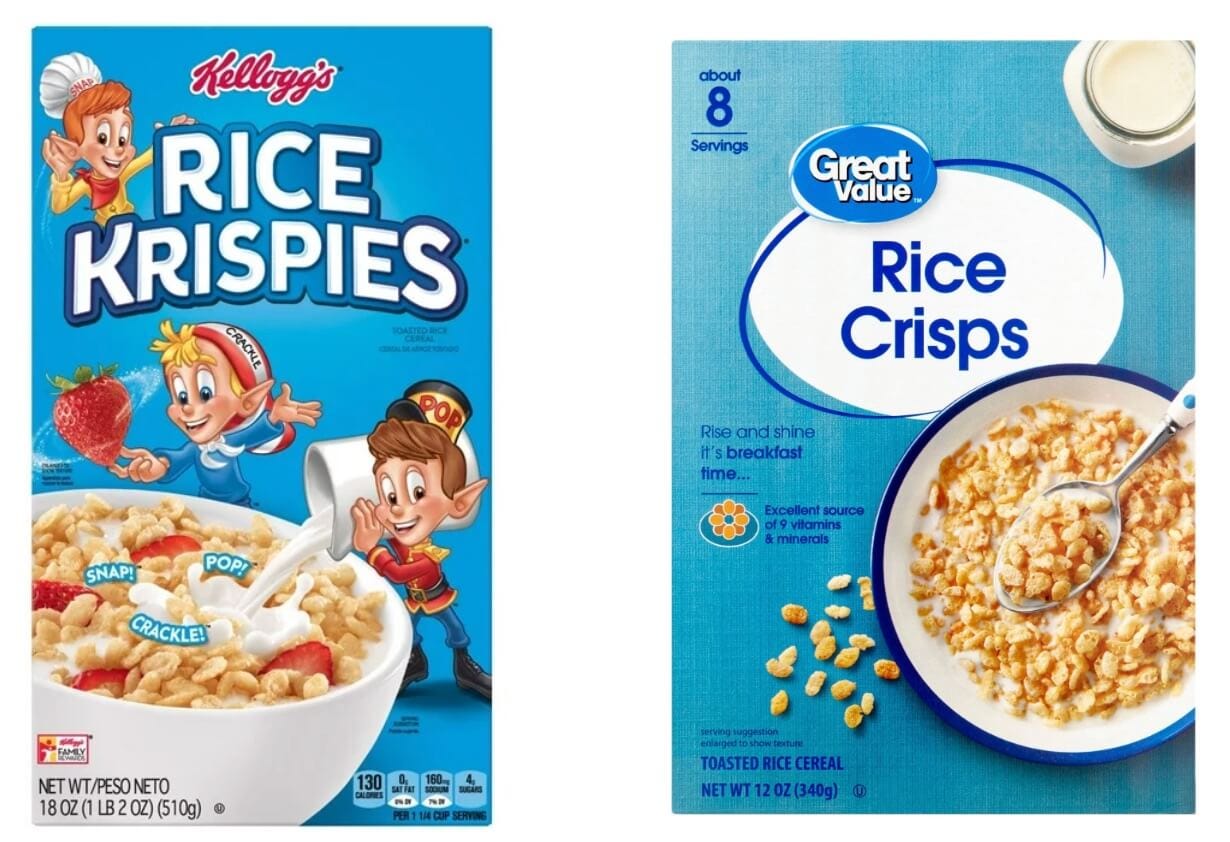
Yeah, it’s sad - that’s what works.
OK, I got worked up. My apologies.
So one of the reasons to use a mascot is to give your brand an identity in a crowded market where consumers have a bunch of choices. The Marlboro Man, Tony the Tiger, Ronald McDonald - those all help consumers remember the feelings they get when they interact with the company, and drive choice when there are a bunch of choices presented.
But that’s not the only reason.
If you have a product that has a less-than-sparkling reputation in the marketplace, a mascot is a way, perhaps, to soften that blow.
You may be familiar with the pesticide DDT.
If you are not familiar with DDT, just know that it was banned in the US in 1972 because of “increased cancer risks, and nervous system toxicity, especially in utero.” Oops!
But before that, they got ahead of their less-than-stellar reputation when they ran this ad:
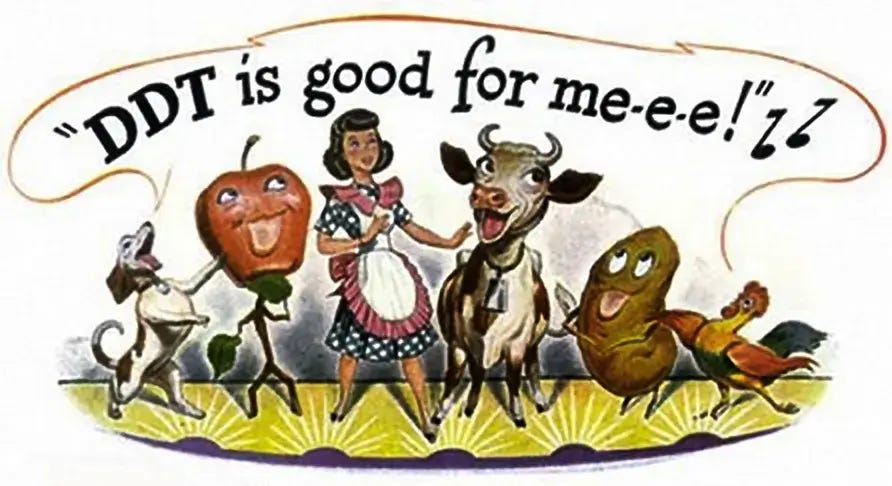
Would a singing apple really represent a product that causes cancer? Of course not! What kind of an apple is that????
Also a singing potato. Certainly a singing potato would only represent goodness. Or being buried in dirt underground. Oh wait…
If you’re under the age of 40, it might seem impossible to imagine that a cigarette company would use this strategy. But you’re underestimating cigarette companies. We old folks remember that Camel cigarettes used the mascot Joe Camel to make cigarettes more appealing to young people. Oops again!
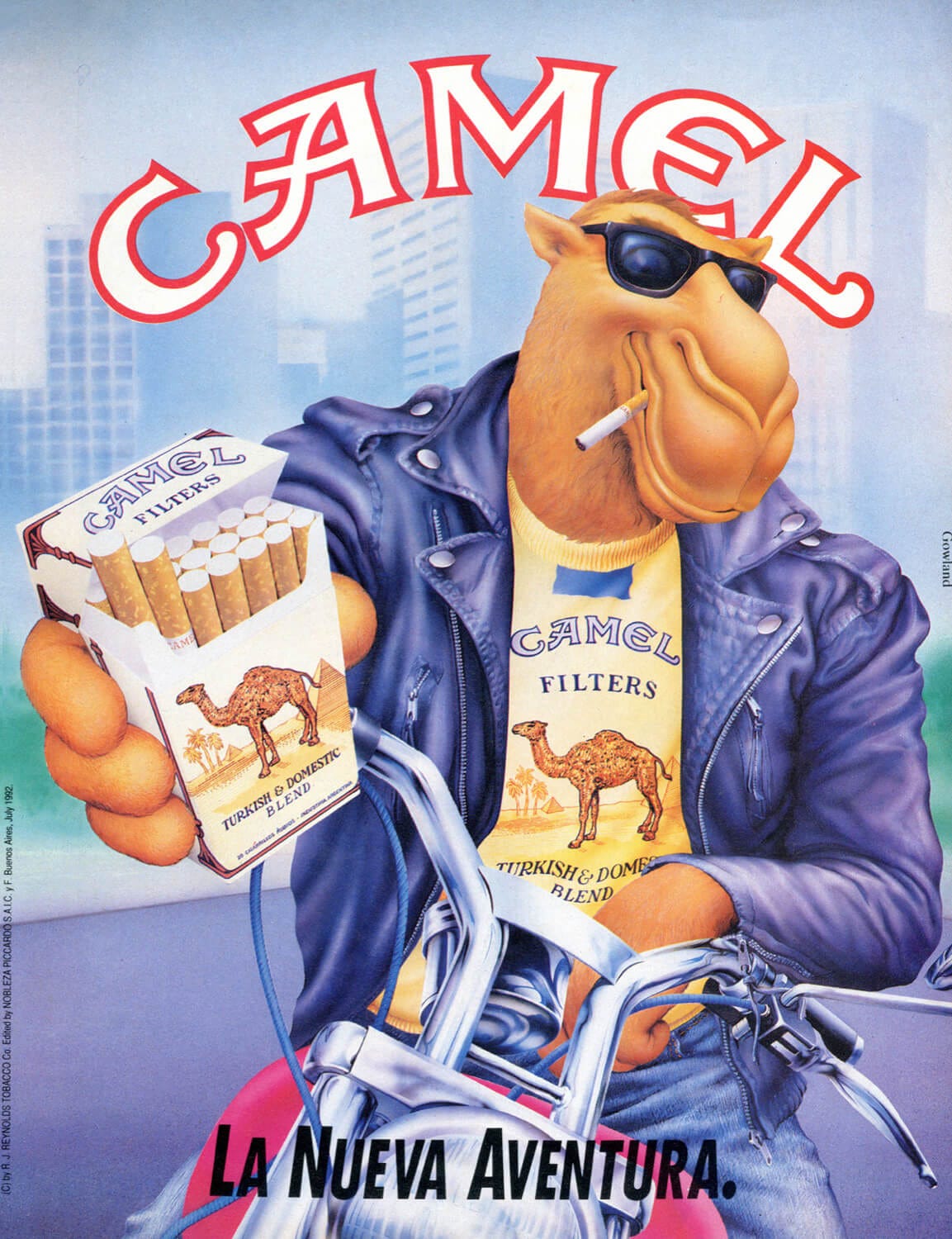
Yes, maybe we look back on that and say, “you have got to be kidding me…but also do they come in menthol? ” But also it moved the conversation away from “everyone knows this product will kill you” to “where can I get a Joe Camel t-shirt?” Like literally that’s how powerful a mascot can be - everyone agrees the product is bad for you, but the mascot steers the conversation toward “however, you can look like the kind of person [or dromedary] who rides a motorcycle if you use this product.”
So before I share why I’m telling you all this, we’re all adults here, right? (because what child would sit and read this?).
I’d like to be able to mention something about a campaign the current administration is running without it becoming a whole thing about the members of the current administration. There are so many places you can go to talk about that. This isn’t one of them.
So, regardless of how you feel about said administration…
Let’s imagine you have taken a job working for the US government’s Office of Surface Mining Reclamation and Enforcement (OSMRE). And then after you take the job you learn that the OSMRE is the governmental office that oversees coal mining.
And then you think to yourself, “we still have coal mining?”
And then another voice in your head says, “of course we still have coal mining. All you liberal big city folks have no idea how real Americans live.”
And then you think, “Oh, there you go again with the whole ‘real Americans’ thing. I think I’ve had just about enough of that. There’s no red America, there’s no blue America, there’s…”
And your other voice responds, “Oh yeah - quoting Barack HUSSEIN Obama is really making a great case that you’re not out of touch with America. Go cry your liberal tears somewhere else.”
And then you think, “I probably need to stop working alone in my house all day.”
And the other voice responds, “You’re not alone, you’re listening to the Ben Shapiro Show.”
Regardless, you’ve got this new marketing job at the OSMRE and you’re tasked with improving the image of coal among the American public. This administration (again, shush!) believes in investing in coal, so there’s going to be investment in coal.
You’re in your fancy new OSMRE marketing job - how would you start to try to let Americans know that maybe coal doesn’t have the negative connotations that they think it has, while making those who feel good about coal feel (somehow?) even better about coal.
Well, as we always say about marketing, you’ve got options:
Option 1: Have the POTUS or other high-ranking official do a whistlestop tour of coal country and show how the investments in coal are paying economic dividends for the happy people of, for example, West Virginia.
Option 2: Have your Secretary of the Interior (who oversees OSMRE) go on the Sunday shows and talk about the investments the country is making in coal and then ignore the questions the host of the Sunday show asks you about why you’re investing in coal instead of renewable energy.
Option 3: Ensure that the White House press secretary is well briefed on coal so that when a reporter asks her about it she mocks them and calls them names. (Hey, me, we said no politics!)
Option 4: Create a mascot named Coalie to represent the cute, cuddly landscape of coal country and to make everyone feel great about coal.
This is partly a trick question - you can do a couple of these (and I would definitely suggest Option 3), but also you’d choose Option 4: Coalie is adorable:
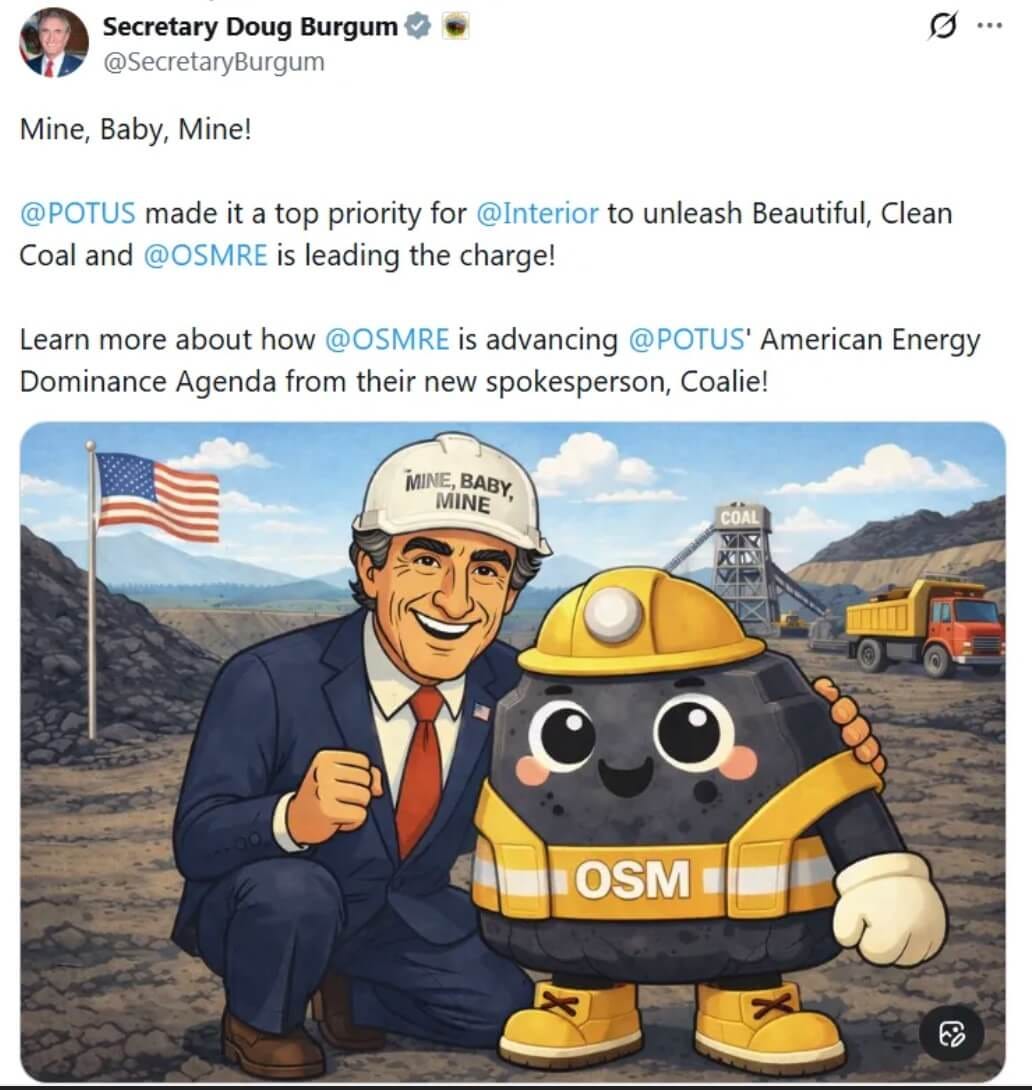
Damn, he’s cute.
And yet.
If we go back to the smiling DDT apple, the apple was smiling because DDT was protecting it from the terrible bugs who wanted to eat it (I mean, yes, at the expense of the health of generations of people who lived anywhere near it…but still).
Coalie is coal and coal is useful when you throw it into a furnace (no! not Coalie! Cooaallllieeeeee!!!!!).
That’s my one piece of advice about creating a mascot - make sure that the adorable mascot you create would not be incinerated if it were used as directed.
Unless, of course, you’re the Cluckin’ Chicken. “The pieces of me get flame broiled!”
As always, thanks for reading to the end it’s the best part…
P.S. - We hit 3,000 Gobbledy subscribers today! That’s a huge milestone for the newsletter - I barely know 4 people outside of my family, so that leaves 2,996 of you whom I don’t know personally who have joined this silly community of readers. It means a lot to me, thank you. And if you enjoy this, please share it with someone. They’ll enjoy it too (and if they don’t, just let me know and I’ll yell at them, like I’m the press secretary).
Just want to say, from all the way over here in the rainy south of England, this is my favourite marketing newsletter. It's always useful and always entertaining. So thank you! Please don't ever stop.
The lack of imagination that went into that mascot is sooooo sad. It looks like they typed a three word prompt into an AI image creator and then named it using a five year old's naming scheme of "object name" + "-ie." Maybe they had to be obvious about it because without it's name telling you exactly what it is, their target audience would be confused.
I offer here some alternative names:
Nat King
Carbon Electra
Ni-coal
Peat
Burnie
Pollutey
Contaminatey
Poisoney